
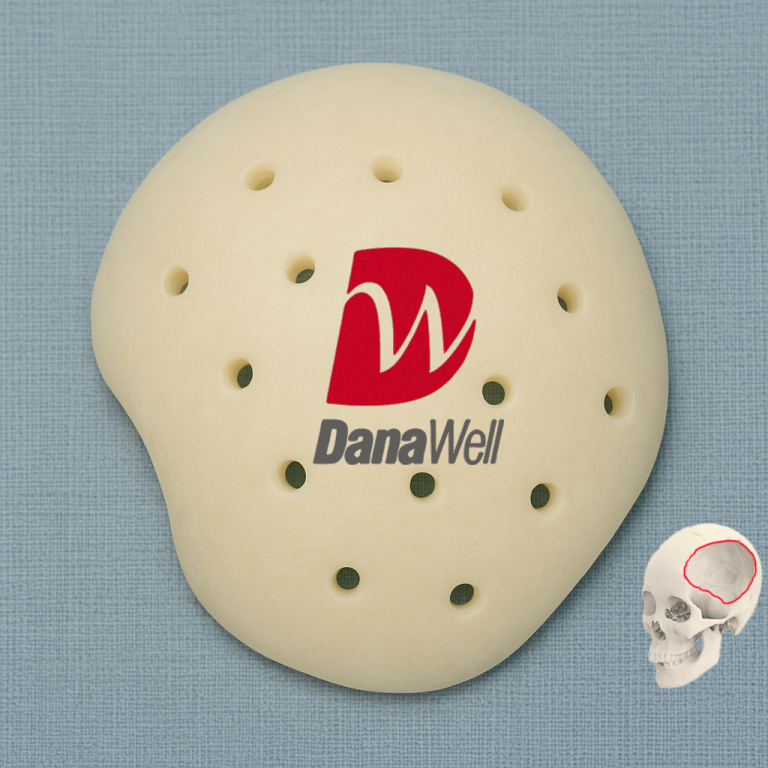
Custom prosthesis material
With the advancement of medical engineering and biocompatible materials manufacturing technology, the use of polymers as the main material in the production of custom-made cranial prostheses has received increasing attention. Danawell Company, as one of the pioneers in the production of this type of prosthesis in Iran, has succeeded in developing high-quality samples that are compatible with the anatomy of patients. In this article, we will take a close look at the advantages of polymers compared to titanium in cranial applications..
Specialized properties of polymers in skull applications
Custom prostheses made with polymers have outstanding physical and biological properties that make them an ideal option for reconstructions of cranial defects:
High adaptation to the body's anatomical structure
Using 3D molding and design technologies, the polymer prostheses produced are perfectly adapted to the shape and curvature of the patient’s skull. This feature allows for a high aesthetic and functional result.
Stable connection to bone tissue
Through their physical properties, custom-made prostheses have the ability to create a strong and uniform connection to the edges of the bone, which in turn increases implant stability and reduces the possibility of displacement.
Fully compatible with medical imaging
One of the major strengths of polymer prostheses is that they do not interfere with imaging techniques such as MRI and CT scans. This advantage is crucial for post-operative evaluations and future diagnostic studies.
Reduces the risk of inflammation and allergic reactions
Due to the absence of metal ions and the biocompatible properties of polymers, the possibility of inflammatory or allergic reactions around the cranial prosthesis is minimized and the patient’s recovery period is facilitated.
Appropriate weight and patient comfort
Custom-made polymer prostheses are significantly lighter than metal prostheses. This increases long-term patient comfort and reduces pressure on surrounding tissues.
Expert comparison with titanium prostheses
Compared to titanium, polymer prostheses have several advantages, including::
- Greater body compatibility: The neutral chemical composition of the polymers greatly reduces the likelihood of irritation or allergies.
- Perfect imaging performance: Unlike titanium, which interferes with MRI and CT, polymer prostheses function without disturbing these processes.
- Thermal insulation: Polymer prostheses have lower thermal conductivity, which prevents the patient from feeling discomfort due to changes in ambient temperature (exposure to sunlight).
- Lower cost: Using this material significantly reduces the final cost of treatment, making it a suitable option for a wide range of patients.
Summary: Cranial prostheses made of polymer bone cement (PMMA) and PEEK are a smart, cost-effective, and high-performance choice that is currently recognized as the best material for producing custom cranial prostheses. Danawell Company, utilizing a team of experts and advanced technology, has succeeded in producing prostheses that best align with the clinical and aesthetic needs of patients.
Contact us for a free consultation.